Thursday, 27 May 2021

A Survey Of Confinement


Plague Covers


Xavier de Maistre, A Journey round my Room, 1794

Geraldine Brooks, Year of Wonders, 2001

Giovanni Boccaccio, The Decameron, c. 1350


Quarantine

Origin: mid 17th Century; from Italian quarantina 'forty days', from quaranta 'forty'

If there's one thing, Dear Reader, we all learned this past year, it is the definition of the word Quarantine. In varying degrees, I expect we all had a chance to find out what forty days at home might even feel like, and probably all came to the conclusion that whoever put the quaranta into it was either wildly optimistic or just deluded. And, for some, confinement may have been a better word for what ensued.

Anyhoo, in the expectation that no time could have been riper, Your Correspondent seized the opportunity to join hands across the centuries with a couple of writers who had their own take on Staying In for a bit, and one modern author who could not have been more prescient in her choice of subject. And appreciating you may be over even reading about these times, I shall merely briefly survey how they fared:

Our traveller Xavier taking in the sights

42 Days: Xavier de Maistre was a a young soldier based in Turin in 1790 when he was confined for forty-two days under house arrest for duelling. He parodies his time as a travelogue, and in A Journey round my Room, he luxuriates in exploring his thirty-six-pace perimeter bedsit, admiring and discoursing on its fixtures, furnishings and bibelots, digressing and pontificating as though on a Grand Tour. 

Verdict: He emerges sane and refreshed at the end of his six-weeks, enabled, of course, by the unwavering companionship of his dog and reliability of his loyal valet who could interface with the outside world for him, with a book under his belt and wholeheartedly recommending this style of Voyage for its frugality and comfort for those with limited means or mobility.

Eyam in happier times in the early C19th

425 Days: Geraldine Brooks, Year of Wonders, is a positively marvellous fictional account of the true story of the small village of Eyam that self-quarantined for a full year when Bubonic Plague came to them for around fourteen months in 1665-6. The story is seen through the eyes of a housemaid who finds herself rising to the occasion and through necessity self-training as a nurse and herbalist as those around sicken and die. Self-sacrifice, selfishness, superstition and survival are explored in this extraordinary tale.

Verdict: Our fictional heroine, one of the survivors, takes on all the shocks and challenges this disaster throws at her and finds that the year, after all, is for her one of wonder. And the real-life village taught doctors valuable lessons in enforced quarantine zones and contamination minimisation, also wonderful. And a 2001 novel about the strange ills of the past that became suddenly very topical again - how could Ms. Brooks have known it!
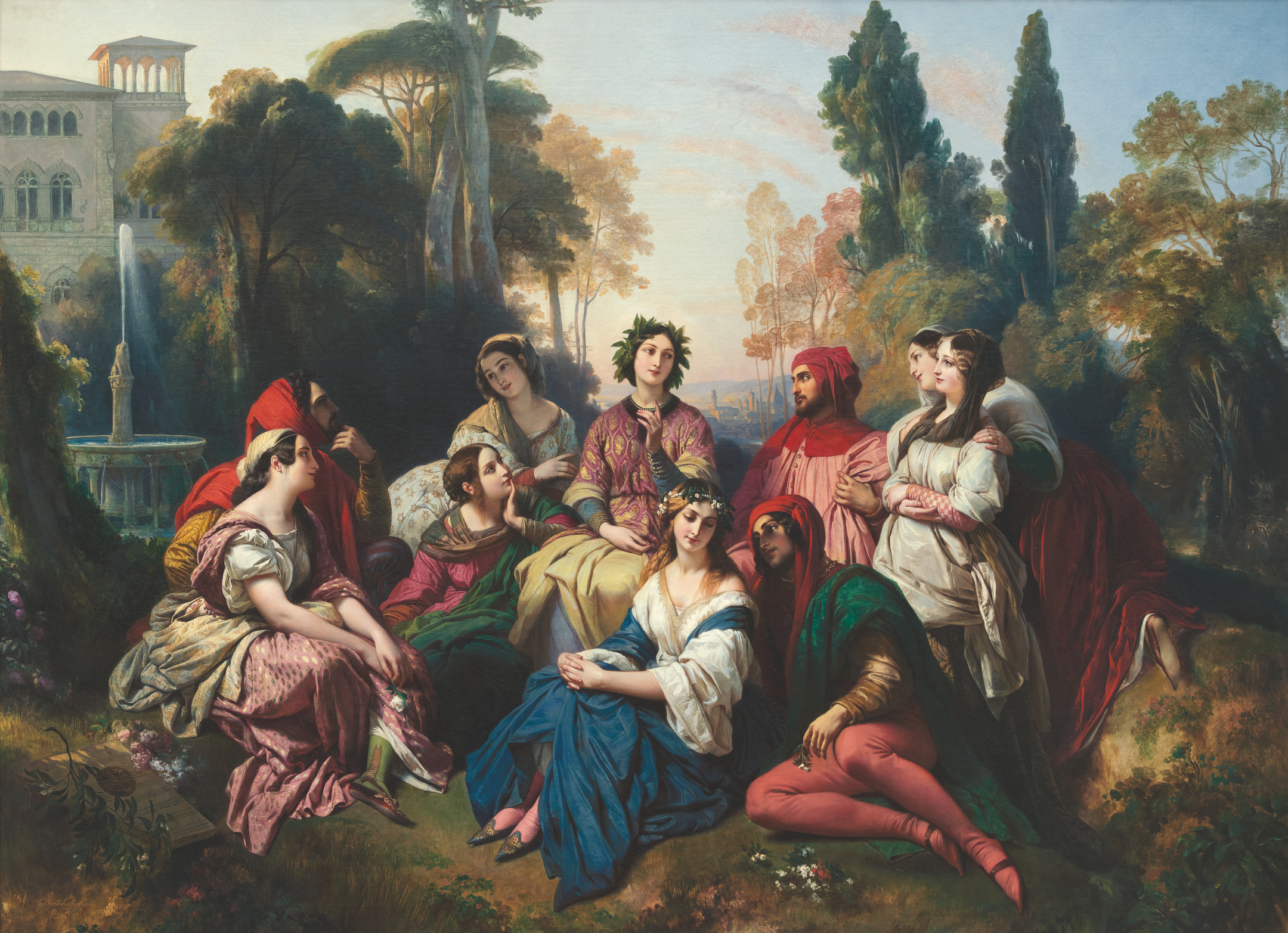
Such a genteel escape from the Black Death
Franz Xaver Winterhalter, The Decameron, 1837

14 Days: Ten affluent young Florentines flee to nearby Fiesole for fourteen days to escape the Bubonic Plague of 1348 and amuse themselves by each telling a story based on a particular theme every weeknight. The 100 stories Giovanni Boccaccio cobbles together are indeed sourced from throughout the preceding ages and many lands, but brought a bit up-to-date (viz. C14th-style) with some local flavour and were probably recognisable to contemporary readers. They are in turns bawdy, lewd, pious, irreverent, violent and a source of great delight and admiration to the ten storytellers. Then, amused and uplifted, they all go back home. [Nota bene: Extensive show-notes accompany this Norton Critical Edition]

Verdict: Do we care? If it wasn't for the entourage of servants that rolled out the red carpet every day for these ridiculous, self-indulgent and pompous youths and they had to fend for themselves for the duration - it's every man for himself when the plague strikes the Middle Ages - they'd probably have perished. 

I do realise this is fiction, obv. and I'm sure Signore Boccaccio probably wrote this as a bit of escapism from the awfulness of living though the Black Death, but did he expect that centuries later this book is still lauded as a masterpiece?? Frankly, Chaucer would have probably come up with enough inspiration for his Canterbury Tales without the leg-up from this nonsense. Pity the poor students who have to critique this. And that careers have been made as Decameron-experts astonishes me. The show notes are just as self-indulgent. Reading this, I took one for the team*.

Conclusion: Does quarantine accurately live up to what is promised on the box? No. Xavier came closest with 42 days, but it was house arrest not escape from pestilence that confined him thus. Unless 40 days is re-instituted as the prescription, Pipistrello thinks it's time for a name change.


* Why I'm all phooey with The Decameron will come as a future post!

Image credits: 1: Flying With Hands; 2: via Internet Archive; 3, 4: Wikimedia Commons


Thursday, 20 May 2021

Clubs For Loose Talk


For a life thus far described as well-crafted along antisocial and team-averse lines, it may surprise you to learn, Dear Reader, that Your Correspondent was once a member of a Club. The University Women's Club, to give it its august title. In London's Mayfair, no less. A quirky, private establishment for, as it says on the box, women-who-went-to-university and where they could socialise, Woosterish fashion, with similar, or just rest their weary brogue-shod feet and have a cup of tea after a hard day's shopping in W1.

Whilst I was working with the standard motley crew of an early-90s merchant bank dealing floor, where retired officer classes rubbed shoulders with Sloaney Ponies, upstart Antipodeans (hullo!) with Hooray Henries, and potty-mouthed Essex Wide Boys with Oxbridge nerds, my opportunity to get first-hand experience of the Clubland that I understood best through the parodic lens of British fiction actually came courtesy of the couple I lodged with for the first six months of London life.

He was a member of the Oxford and Cambridge Club on Pall Mall, an older and rather more illustrious, if not notorious, club and where I managed to disgrace myself* the one and only time I was invited for lunch with him and his wife and sister. The crisp snapping of newspapers and audible sniffing was as far as the punishment went for my youthful interpretation of singing for my supper, but I was never invited back for a repeat performance, shall we say!

Not to worry, for the University Women's Club beckoned, as my host's wife and sister, a Committee member, were especially keen to have a 20-something on their club register, overlooking my apparent penchant for loose talk. It seemed membership was withering on the vine and the average age of their Ladies was becoming ancient, so it was rather hoped that I'd lure onto the books more young gals from the banking coalface.** 

It was all rather quaint and nice, but the food was rather uninspired and it ultimately wasn't really terribly handy for me to utilise regularly. So, apart from attending the occasional lecture or event dinner, I didn't use it much and, frankly, it didn't live up to the eccentric expectations I'd had about such a place. Except in one respect.

One of the more elderly members would claim as her own the doorman's chair that sat directly inside the front entrance. From this pole position she could see all comers and preside over the passage of members across the lobby where, of course, all action took place ... and, as she seemed to suffer from Tourette's syndrome, make rather, ahem, unsavoury, loud comments about them as they passed. While everyone studiously Pretended Not To Hear the salty language the poor dear would come out with, gaily covering up the blushes on the unwary targets, each visit to my club was a veritable master class in loose talk.


* I was regaling them with the occasion of some unexpected cattiness between two lady tennis commentators on the telly in Australia when I was a teenager and whose microphones were still on when they cut to a commercial break. The slight dining room hum which had disguised my anecdote unfortunately dipped momentarily into silence, just as ol' Pipistrello sailed into the punchline about what one lady commentator said she would do to the other if she didn't desist in whatever the unseen annoyance was.

** They did rather overestimate my sociabilities there as I recruited not a one!


Image credit: Flying With Hands


Tuesday, 27 April 2021

Madness & Taxes In The 27th Kingdom

C16th manuscript illumination


Alice Thomas Ellis, The 27th Kingdom, 1982

Have you ever had a difference of opinion with the Taxman, Dear Reader? It is a tiresome affair. But one can be grateful that we're not under the C14th reign of Ivan I, Prince of Moscow and Grand Prince Vladimir, whereupon tax collectors took a rather more hands-on approach to extracting pesos from reluctant subjects for their Sovereign overlord, as is fetchingly illuminated above. 


But at some point, the tables must have turned even in Russia, as Aunt Irene, hailing from a family of Roman Catholic émigrés who fled from that hallowed homeland across lands and countries and is presently finding herself at odds with the Inland Revenue in the 27th Kingdom, reflects:

Some minor official had been persecuting her for months with trivial enquiries about her means; but since she couldn't bear forms and had a profound conviction that her need of her own money was greater than the government's, she had ignored him. She felt the noble irritation of a fine spirit called from viewing the sunset to inspect the blockage in the kitchen sink. Her ancestors, she thought, would have him boiled. In oil.
 
I suspect that a general survey across most Kingdoms today would find that Taxmen operate somewhere betwixt the thrashing of subjects and being themselves boiled in oil. While for the taxpayer, these outgoings are still an affliction to be borne like madness. 

Aunt Irene went through the various forms of tragedy that afflict the living: madness and death duties for the upper classes, hunger and indignity for the lower, the eldest son's marriage to the girl on the haberdashery counter for the middle.

Warm and generous Aunt Irene, who presides over her cosy dominion in 1954 Chelsea, finds plenty with which to philosophise further in Alice Thomas Ellis's little gem of a 1982 Booker-Prize-shortlisted novel, The 27th Kingdom. 

"'Why are you looking like that?' asked Kyril.

'I was wondering why people put ferrets in their trousers,' said Aunt Irene.

'Thanatos,' said Kyril. 'An illustration of the death wish.'

'What I wish,' said Aunt Irene, 'is that you'd never read Freud. It's had a very leaden effect on your conversation.'"

The Ferret
Thomas Bewick wood engraving, 1790

As you may guess, this book finds natural endorsement by the Flying With Hands Department of Whimsy for its light and fanciful touch, as opposed to the withering review I found by a New York Times reviewer (bandying about such words as cocksure, facetious, smirky, tired, done to death - phooey! and one who evidently cannot enjoy 150-odd pages of slightly mad company.) Kyril, by the way, is the odious nephew of Aunt Irene and rather considers himself irresistible for both his beauty and his charming wisdom:

"'He's one of those people,' said Kyril, 'who once they go into analysis never never come out - which wouldn't matter if they'd keep it to themselves, but then they never talk about anything else. It gets to be a way of life, and they become extremely earnest and keep examining their motives and looking straight into other people's eyes, and yakking on about transference and ambivalence and complexes until you could murder them. It renders them entirely unfit for human society.'"

It is into her bohemian yet genteel home, Dancing Master House, that Aunt Irene (whose "own looks had gone - disappeared under waves of creamy, curdling flesh. How odd that bones, reminders of old mortality, should be considered essential to beauty in this perverse age") takes in a luminous, Caribbean postulant, Valentine. And the assembled cast of lodger (sad Little Mr. Sirocco) and Kyril's tormented lovers, char-women Mrs. Mason (fallen on hard times and resentful) and Mrs. O'Connor (with the shady side-hustles and jolly), and a cat with more sense than most of them has a mysterious new member.

Valentine it seems, has been sent by Irene's sister, the Mother Superior of a Welsh convent, to rub shoulders with the earthly and hopefully lose some of her unsettling, slightly saintly qualities. For in amongst the still pocked, post-war landscape of London there is plenty of space for a thaumaturge to float relatively unnoticed among the mortal and venial sinners, and take the pressure off the quiet convent.

Thaumaturgy in action, or
A Miracle of Saint Joseph of Cupertino
Placido Costanzi, 1750

But it's not all sweetness and light in this slight, supernatural tale. Times are hard and housing is still short. The recent war has left its scars on the city and its people, and opportunists abound. "There was, thought Aunt Irene, a glaring thread of madness in human affairs which shed about it a short, confounding light towards which people were drawn like death-drugged gnats." 

Not to mention that lurking tax man. After a worrying visit from him, Aunt Irene is served a restorative cup of tooth-stripping tea in her own good china by the jollier of her charwomen, Mrs. O'Connor. "The world was upside down. On the whole this pleased Aunt Irene as much as it angered Mrs Mason. It was more interesting that way, but it was hard on the porcelain."


Image credits: 1: GrangerAcademic.com; 2: Flying With Hands; 3: V&A Museum; 4: Wikimedia Commons


Bats In The Belfry